EXERCISE 7.2
Coordinate Geometry • 10 Questions
Question 1
Hint available
Find the coordinates of the point which divides the join of (–1, 7) and (4, –3) in the ratio 2 : 3.
Key Idea
Use the section formula (internal division) for coordinates. If a point P(x, y) divides the line segment joining A(x₁, y₁) and B(x₂, y₂) in the ratio m : n, then \(x = \frac{nx_1 + mx_2}{m+n}\) and \(y = \frac{ny_1 + my_2}{m+n}\).
Step-by-Step Solution
1. Identify the given points:
\[A \equiv (-1,\,7)\quad\text{and}\quad B \equiv (4,\,-3)\]
2. The required point P divides AB internally in the ratio \(m:n = 2:3\) (i.e., \(AP : PB = 2 : 3\)).
3. Apply the section formula:
\[x_P = \frac{n\,x_A + m\,x_B}{m+n},\qquad y_P = \frac{n\,y_A + m\,y_B}{m+n}\]
Here, \(x_A = -1,\; y_A = 7,\; x_B = 4,\; y_B = -3,\; m = 2,\; n = 3\).
4. Compute the x‑coordinate:
\[x_P = \frac{3(-1) + 2(4)}{2+3} = \frac{-3 + 8}{5} = \frac{5}{5} = 1\]
5. Compute the y‑coordinate:
\[y_P = \frac{3(7) + 2(-3)}{2+3} = \frac{21 - 6}{5} = \frac{15}{5} = 3\]
6. Hence the required point P is \((1,\,3)\).
\[A \equiv (-1,\,7)\quad\text{and}\quad B \equiv (4,\,-3)\]
2. The required point P divides AB internally in the ratio \(m:n = 2:3\) (i.e., \(AP : PB = 2 : 3\)).
3. Apply the section formula:
\[x_P = \frac{n\,x_A + m\,x_B}{m+n},\qquad y_P = \frac{n\,y_A + m\,y_B}{m+n}\]
Here, \(x_A = -1,\; y_A = 7,\; x_B = 4,\; y_B = -3,\; m = 2,\; n = 3\).
4. Compute the x‑coordinate:
\[x_P = \frac{3(-1) + 2(4)}{2+3} = \frac{-3 + 8}{5} = \frac{5}{5} = 1\]
5. Compute the y‑coordinate:
\[y_P = \frac{3(7) + 2(-3)}{2+3} = \frac{21 - 6}{5} = \frac{15}{5} = 3\]
6. Hence the required point P is \((1,\,3)\).
Question 2
Hint available
Find the coordinates of the points of trisection of the line segment joining (4, –1) and (–2, –3).
Key Idea
Use the section formula (or vector method) for internal division of a line segment. For trisection, the segment is divided in the ratios 1:2 and 2:1.
Step-by-Step Solution
1. Let the end points be \(A(4,-1)\) and \(B(-2,-3)\).\
2. The vector \(\overrightarrow{AB}\) = \((-2-4,\; -3-(-1))\) = \((-6,\; -2)\).\
3. For the first point of trisection \(P\) (closer to \(A\)), the ratio \(AP:PB = 1:2\). Hence \(P\) is located at one‑third of the way from \(A\) to \(B\):\
\[\begin{aligned}
x_P &= x_A + \frac{1}{3}(x_B - x_A) = 4 + \frac{1}{3}(-2-4) = 4 - 2 = 2,\\
y_P &= y_A + \frac{1}{3}(y_B - y_A) = -1 + \frac{1}{3}(-3+1) = -1 - \frac{2}{3} = -\frac{5}{3}.
\end{aligned}\]
So \(P(2, -\frac{5}{3})\).\
4. For the second point of trisection \(Q\) (closer to \(B\)), the ratio \(AQ:QB = 2:1\). Hence \(Q\) is located at two‑thirds of the way from \(A\) to \(B\):\
\[\begin{aligned}
x_Q &= x_A + \frac{2}{3}(x_B - x_A) = 4 + \frac{2}{3}(-6) = 4 - 4 = 0,\\
y_Q &= y_A + \frac{2}{3}(y_B - y_A) = -1 + \frac{2}{3}(-2) = -1 - \frac{4}{3} = -\frac{7}{3}.
\end{aligned}\]
So \(Q(0, -\frac{7}{3})\).\
5. Hence the two points that trisect the segment \(AB\) are \((2, -\frac{5}{3})\) and \((0, -\frac{7}{3})\).
2. The vector \(\overrightarrow{AB}\) = \((-2-4,\; -3-(-1))\) = \((-6,\; -2)\).\
3. For the first point of trisection \(P\) (closer to \(A\)), the ratio \(AP:PB = 1:2\). Hence \(P\) is located at one‑third of the way from \(A\) to \(B\):\
\[\begin{aligned}
x_P &= x_A + \frac{1}{3}(x_B - x_A) = 4 + \frac{1}{3}(-2-4) = 4 - 2 = 2,\\
y_P &= y_A + \frac{1}{3}(y_B - y_A) = -1 + \frac{1}{3}(-3+1) = -1 - \frac{2}{3} = -\frac{5}{3}.
\end{aligned}\]
So \(P(2, -\frac{5}{3})\).\
4. For the second point of trisection \(Q\) (closer to \(B\)), the ratio \(AQ:QB = 2:1\). Hence \(Q\) is located at two‑thirds of the way from \(A\) to \(B\):\
\[\begin{aligned}
x_Q &= x_A + \frac{2}{3}(x_B - x_A) = 4 + \frac{2}{3}(-6) = 4 - 4 = 0,\\
y_Q &= y_A + \frac{2}{3}(y_B - y_A) = -1 + \frac{2}{3}(-2) = -1 - \frac{4}{3} = -\frac{7}{3}.
\end{aligned}\]
So \(Q(0, -\frac{7}{3})\).\
5. Hence the two points that trisect the segment \(AB\) are \((2, -\frac{5}{3})\) and \((0, -\frac{7}{3})\).
Question 3
Hint available
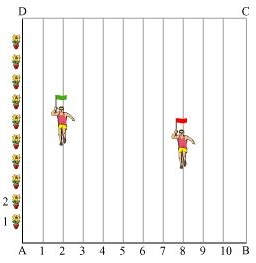
To conduct Sports Day activities, in your rectangular shaped school ground ABCD, lines have been drawn with chalk powder at a distance of 1m each. 100 flower pots have been placed at a distance of 1m from each other along AD, as shown in Fig. 7.12. Niharika runs 1 4 th the distance AD on the 2nd line and posts a green flag. Preet runs 1 5 th the distance AD on the eighth line and posts a red flag. What is the distance between both the flags? If Rashmi has to post a blue flag exactly halfway between the line segment joining the two flags, where should she post her flag?
Key Idea
Use a coordinate system to represent the rectangular ground. Apply the distance formula \(d = \sqrt{(x_2-x_1)^2+(y_2-y_1)^2}\) to find the distance between the two flags and the midpoint formula \(M\left(\frac{x_1+x_2}{2},\frac{y_1+y_2}{2}\right)\) to locate the position of the blue flag.
Step-by-Step Solution
1. Set up the coordinate system – Take \(A\) as the origin \((0,0)\) and let the side \(AD\) lie on the \(y\)-axis. Since 100 flower pots are placed 1 m apart on \(AD\), the length \(AD = 100\) m, so \(D\) is at \((0,100)\).
2. Identify the vertical lines – The lines drawn at 1 m intervals are parallel to \(AD\). The 2nd line is therefore the line \(x = 1\) and the 8th line is the line \(x = 7\).
3. Coordinates of the green flag (G) – Niharika runs \(\frac{1}{4}\) of \(AD\) i.e. \(\frac{1}{4}\times100 = 25\) m on the 2nd line. Hence \(G\) has coordinates \((1, 25)\).
4. Coordinates of the red flag (R) – Preet runs \(\frac{1}{5}\) of \(AD\) i.e. \(\frac{1}{5}\times100 = 20\) m on the 8th line. Hence \(R\) has coordinates \((7, 20)\).
5. Distance between the two flags – Using the distance formula:
$$\begin{aligned}
GR &= \sqrt{(7-1)^2 + (20-25)^2} \\
&= \sqrt{6^2 + (-5)^2} \\
&= \sqrt{36+25} \\
&= \sqrt{61}\ \text{m} \approx 7.81\ \text{m}
\end{aligned}$$
6. Mid‑point of \(GR\) – The point exactly halfway between the two flags is the midpoint:
$$M\left(\frac{1+7}{2},\frac{25+20}{2}\right) = (4, 22.5)$$
Thus Rashmi should place the blue flag at the point \((4, 22.5)\), i.e. on the 5th vertical line, 22.5 m above point \(A\).
2. Identify the vertical lines – The lines drawn at 1 m intervals are parallel to \(AD\). The 2nd line is therefore the line \(x = 1\) and the 8th line is the line \(x = 7\).
3. Coordinates of the green flag (G) – Niharika runs \(\frac{1}{4}\) of \(AD\) i.e. \(\frac{1}{4}\times100 = 25\) m on the 2nd line. Hence \(G\) has coordinates \((1, 25)\).
4. Coordinates of the red flag (R) – Preet runs \(\frac{1}{5}\) of \(AD\) i.e. \(\frac{1}{5}\times100 = 20\) m on the 8th line. Hence \(R\) has coordinates \((7, 20)\).
5. Distance between the two flags – Using the distance formula:
$$\begin{aligned}
GR &= \sqrt{(7-1)^2 + (20-25)^2} \\
&= \sqrt{6^2 + (-5)^2} \\
&= \sqrt{36+25} \\
&= \sqrt{61}\ \text{m} \approx 7.81\ \text{m}
\end{aligned}$$
6. Mid‑point of \(GR\) – The point exactly halfway between the two flags is the midpoint:
$$M\left(\frac{1+7}{2},\frac{25+20}{2}\right) = (4, 22.5)$$
Thus Rashmi should place the blue flag at the point \((4, 22.5)\), i.e. on the 5th vertical line, 22.5 m above point \(A\).
Question 4
Hint available
Find the ratio in which the line segment joining the points (– 3, 10) and (6, – 8) is divided by (– 1, 6).
Key Idea
Use the section formula (internal division) which states that if a point P(x, y) divides the line segment joining A(x₁, y₁) and B(x₂, y₂) in the ratio m:n (i.e., AP : PB = m : n), then \[ x = \frac{n x_1 + m x_2}{m+n}, \qquad y = \frac{n y_1 + m y_2}{m+n}. \] Solve for the ratio m:n using the given coordinates.
Step-by-Step Solution
1. Identify the given points\
\[ A(-3,\,10), \quad B(6,\,-8), \quad P(-1,\,6). \]\
2. Assume the required ratio\
Let \(AP : PB = m : n\). Here \(m\) corresponds to the part from \(A\) to \(P\) and \(n\) to the part from \(P\) to \(B\).\
3. Write the section‑formula equations\
\[ -1 = \frac{n(-3) + m(6)}{m+n}, \qquad 6 = \frac{n(10) + m(-8)}{m+n}. \]\
4. Clear the denominators\
\[ - (m+n) = -3n + 6m \quad\Rightarrow\quad m+n = 3n - 6m \quad\text{(i)} \]
\[ 6(m+n) = 10n - 8m \quad\Rightarrow\quad 6m + 6n = 10n - 8m \quad\text{(ii)} \]
5. Solve the simultaneous equations\
From (i): \(m + n = 3n - 6m \Rightarrow 7m = 2n \Rightarrow n = \frac{7}{2}m\).\
Substitute \(n = \frac{7}{2}m\) in (ii):\
\(6m + 6\left(\frac{7}{2}m\right) = 10\left(\frac{7}{2}m\right) - 8m\) which is satisfied, confirming the relation.\
6. Find the simplest integer ratio\
\(n = \frac{7}{2}m \Rightarrow \frac{m}{n} = \frac{2}{7}.\)\
Hence \(AP : PB = m : n = 2 : 7\).\
7. Verification (optional)\
Using the ratio 2:7, the coordinates of the dividing point are\
\[ x = \frac{7(-3) + 2(6)}{2+7} = \frac{-21 + 12}{9} = -1, \]
\[ y = \frac{7(10) + 2(-8)}{9} = \frac{70 - 16}{9} = 6, \]
which matches the given point \((-1,6)\).
\[ A(-3,\,10), \quad B(6,\,-8), \quad P(-1,\,6). \]\
2. Assume the required ratio\
Let \(AP : PB = m : n\). Here \(m\) corresponds to the part from \(A\) to \(P\) and \(n\) to the part from \(P\) to \(B\).\
3. Write the section‑formula equations\
\[ -1 = \frac{n(-3) + m(6)}{m+n}, \qquad 6 = \frac{n(10) + m(-8)}{m+n}. \]\
4. Clear the denominators\
\[ - (m+n) = -3n + 6m \quad\Rightarrow\quad m+n = 3n - 6m \quad\text{(i)} \]
\[ 6(m+n) = 10n - 8m \quad\Rightarrow\quad 6m + 6n = 10n - 8m \quad\text{(ii)} \]
5. Solve the simultaneous equations\
From (i): \(m + n = 3n - 6m \Rightarrow 7m = 2n \Rightarrow n = \frac{7}{2}m\).\
Substitute \(n = \frac{7}{2}m\) in (ii):\
\(6m + 6\left(\frac{7}{2}m\right) = 10\left(\frac{7}{2}m\right) - 8m\) which is satisfied, confirming the relation.\
6. Find the simplest integer ratio\
\(n = \frac{7}{2}m \Rightarrow \frac{m}{n} = \frac{2}{7}.\)\
Hence \(AP : PB = m : n = 2 : 7\).\
7. Verification (optional)\
Using the ratio 2:7, the coordinates of the dividing point are\
\[ x = \frac{7(-3) + 2(6)}{2+7} = \frac{-21 + 12}{9} = -1, \]
\[ y = \frac{7(10) + 2(-8)}{9} = \frac{70 - 16}{9} = 6, \]
which matches the given point \((-1,6)\).
Question 5
Hint available
Find the ratio in which the line segment joining A(1, – 5) and B(– 4, 5) is divided by the x-axis. Also find the coordinates of the point of division.
Key Idea
Use the section formula (internal division) for a point dividing a line segment in the ratio \(m:n\). Since the required point lies on the x‑axis, its y‑coordinate is zero. Set the y‑coordinate from the section formula to zero and solve for the ratio \(m:n\). Then substitute the ratio back into the formula to obtain the x‑coordinate.
Step-by-Step Solution
1. Let the required point be \(P(x,0)\), which divides the segment \(AB\) internally in the ratio \(m:n\) (i.e., \(AP:PB = m:n\)).
2. Section formula (internal division):
$$\begin{aligned}
x &= \frac{m\,x_B + n\,x_A}{m+n},\\[4pt]
y &= \frac{m\,y_B + n\,y_A}{m+n}.
\end{aligned}$$
Here \(A(1,-5)\) and \(B(-4,5)\).
3. Use the condition \(y=0\) (since \(P\) lies on the x‑axis):
$$0 = \frac{m\cdot 5 + n\cdot (-5)}{m+n} \;\Rightarrow\; 5m - 5n = 0 \;\Rightarrow\; m = n.$$
Hence the line segment is divided in the ratio \(1:1\) (the midpoint).
4. Find the x‑coordinate using \(m=n\):
$$x = \frac{m\,(-4) + n\,(1)}{m+n}
= \frac{-4m + n}{2m}
= \frac{-4m + m}{2m}
= \frac{-3m}{2m}
= -\frac{3}{2}.$$
5. Coordinates of the point of division:
$$P\left(-\frac{3}{2},\;0\right).$$
6. Answer: The x‑axis divides the segment \(AB\) in the ratio \(1:1\) and the point of division is \\((-\frac{3}{2},\;0)\).
2. Section formula (internal division):
$$\begin{aligned}
x &= \frac{m\,x_B + n\,x_A}{m+n},\\[4pt]
y &= \frac{m\,y_B + n\,y_A}{m+n}.
\end{aligned}$$
Here \(A(1,-5)\) and \(B(-4,5)\).
3. Use the condition \(y=0\) (since \(P\) lies on the x‑axis):
$$0 = \frac{m\cdot 5 + n\cdot (-5)}{m+n} \;\Rightarrow\; 5m - 5n = 0 \;\Rightarrow\; m = n.$$
Hence the line segment is divided in the ratio \(1:1\) (the midpoint).
4. Find the x‑coordinate using \(m=n\):
$$x = \frac{m\,(-4) + n\,(1)}{m+n}
= \frac{-4m + n}{2m}
= \frac{-4m + m}{2m}
= \frac{-3m}{2m}
= -\frac{3}{2}.$$
5. Coordinates of the point of division:
$$P\left(-\frac{3}{2},\;0\right).$$
6. Answer: The x‑axis divides the segment \(AB\) in the ratio \(1:1\) and the point of division is \\((-\frac{3}{2},\;0)\).
Question 6
Hint available
If (1, 2), (4, y), (x, 6) and (3, 5) are the vertices of a parallelogram taken in order, find x and y.
Key Idea
In a parallelogram the diagonals bisect each other. Hence the mid‑point of one diagonal equals the mid‑point of the other diagonal.
Step-by-Step Solution
Let the vertices be taken in order as \(A(1,2),\; B(4,y),\; C(x,6),\; D(3,5)\).
1. Use the property of diagonals: In a parallelogram, the mid‑point of diagonal \(AC\) is the same as the mid‑point of diagonal \(BD\).
2. Find the mid‑point of \(AC\):
$$\text{Midpoint of } AC = \left(\frac{1+x}{2},\; \frac{2+6}{2}\right) = \left(\frac{1+x}{2},\; 4\right).$$
3. Find the mid‑point of \(BD\):
$$\text{Midpoint of } BD = \left(\frac{4+3}{2},\; \frac{y+5}{2}\right) = \left(\frac{7}{2},\; \frac{y+5}{2}\right).$$
4. Equate the two mid‑points (since they must be identical):
\[
\frac{1+x}{2} = \frac{7}{2} \quad \text{and} \quad 4 = \frac{y+5}{2}.
\]
5. Solve for \(x\):
\[
\frac{1+x}{2} = \frac{7}{2} \Rightarrow 1 + x = 7 \Rightarrow x = 6.
\]
6. Solve for \(y\):
\[
4 = \frac{y+5}{2} \Rightarrow y + 5 = 8 \Rightarrow y = 3.
\]
7. Verification (optional): Check that opposite sides are parallel and equal.
- \(AB = (4-1,\; y-2) = (3,1)\) and \(CD = (3-6,\; 5-6) = (-3,-1)\) → same magnitude, opposite direction.
- \(BC = (x-4,\; 6-y) = (2,3)\) and \(AD = (3-1,\; 5-2) = (2,3)\) → equal.
Hence the quadrilateral is indeed a parallelogram.
Therefore, \(x = 6\) and \(y = 3\).
1. Use the property of diagonals: In a parallelogram, the mid‑point of diagonal \(AC\) is the same as the mid‑point of diagonal \(BD\).
2. Find the mid‑point of \(AC\):
$$\text{Midpoint of } AC = \left(\frac{1+x}{2},\; \frac{2+6}{2}\right) = \left(\frac{1+x}{2},\; 4\right).$$
3. Find the mid‑point of \(BD\):
$$\text{Midpoint of } BD = \left(\frac{4+3}{2},\; \frac{y+5}{2}\right) = \left(\frac{7}{2},\; \frac{y+5}{2}\right).$$
4. Equate the two mid‑points (since they must be identical):
\[
\frac{1+x}{2} = \frac{7}{2} \quad \text{and} \quad 4 = \frac{y+5}{2}.
\]
5. Solve for \(x\):
\[
\frac{1+x}{2} = \frac{7}{2} \Rightarrow 1 + x = 7 \Rightarrow x = 6.
\]
6. Solve for \(y\):
\[
4 = \frac{y+5}{2} \Rightarrow y + 5 = 8 \Rightarrow y = 3.
\]
7. Verification (optional): Check that opposite sides are parallel and equal.
- \(AB = (4-1,\; y-2) = (3,1)\) and \(CD = (3-6,\; 5-6) = (-3,-1)\) → same magnitude, opposite direction.
- \(BC = (x-4,\; 6-y) = (2,3)\) and \(AD = (3-1,\; 5-2) = (2,3)\) → equal.
Hence the quadrilateral is indeed a parallelogram.
Therefore, \(x = 6\) and \(y = 3\).
Question 7
Hint available
Find the coordinates of a point A, where AB is the diameter of a circle whose centre is (2, – 3) and B is (1, 4).
Key Idea
For a diameter AB of a circle, the centre of the circle is the midpoint of AB. Use the midpoint formula \(M\left(\frac{x_1+x_2}{2},\frac{y_1+y_2}{2}\right)\) and equate it to the given centre.
Step-by-Step Solution
1. Let the required point be \(A(x_1, y_1)\) and the given point be \(B(1, 4)\).\
2. Since AB is a diameter, the centre \(C(2, -3)\) is the midpoint of AB.\
3. Apply the midpoint formula:
\[\left(\frac{x_1+1}{2},\frac{y_1+4}{2}\right) = (2, -3)\]\
4. Equate the corresponding coordinates:
\[\frac{x_1+1}{2}=2 \quad\text{and}\quad \frac{y_1+4}{2}=-3\]\
5. Solve each equation:
- From \(\frac{x_1+1}{2}=2\): \(x_1+1 = 4 \Rightarrow x_1 = 3\).\
- From \(\frac{y_1+4}{2}=-3\): \(y_1+4 = -6 \Rightarrow y_1 = -10\).\
6. Hence the coordinates of point \(A\) are \((3, -10)\).
2. Since AB is a diameter, the centre \(C(2, -3)\) is the midpoint of AB.\
3. Apply the midpoint formula:
\[\left(\frac{x_1+1}{2},\frac{y_1+4}{2}\right) = (2, -3)\]\
4. Equate the corresponding coordinates:
\[\frac{x_1+1}{2}=2 \quad\text{and}\quad \frac{y_1+4}{2}=-3\]\
5. Solve each equation:
- From \(\frac{x_1+1}{2}=2\): \(x_1+1 = 4 \Rightarrow x_1 = 3\).\
- From \(\frac{y_1+4}{2}=-3\): \(y_1+4 = -6 \Rightarrow y_1 = -10\).\
6. Hence the coordinates of point \(A\) are \((3, -10)\).
Question 8
Hint available
If A and B are (– 2, – 2) and (2, – 4), respectively, find the coordinates of P such that AP = 3 AB 7 and P lies on the line segment AB.
Key Idea
Use the section formula for internal division of a line segment. If a point P divides AB internally in the ratio m:n (i.e., AP : PB = m : n), then \(P\bigl(\frac{n x_1 + m x_2}{m+n},\frac{n y_1 + m y_2}{m+n}\bigr)\), where \((x_1,y_1)\) and \((x_2,y_2)\) are the coordinates of A and B respectively.
Step-by-Step Solution
1. Interpret the given condition\
The statement "AP = 3 AB 7" in NCERT notation means \(AP = \frac{3}{7} \; AB\). Hence \(AP : PB = 3 : 4\) because \(AB = AP + PB\).
2. Identify the ratio\
Let \(m = AP = 3\) and \(n = PB = 4\). So the required ratio is \(m:n = 3:4\).
3. Write the coordinates of A and B\
\[A\equiv (x_1,y_1) = (-2,-2), \quad B\equiv (x_2,y_2) = (2,-4).\]
4. Apply the section formula\
\[P\biggl(\frac{n x_1 + m x_2}{m+n},\;\frac{n y_1 + m y_2}{m+n}\biggr)\]
Substituting \(m=3,\;n=4\):\
\[\begin{aligned}
x_P &= \frac{4(-2) + 3(2)}{3+4} = \frac{-8 + 6}{7} = \frac{-2}{7},\\[4pt]
y_P &= \frac{4(-2) + 3(-4)}{3+4} = \frac{-8 -12}{7} = \frac{-20}{7}.
\end{aligned}\]
5. Result\
Hence the coordinates of point \(P\) are \(\displaystyle \left(-\frac{2}{7},\; -\frac{20}{7}\right)\).
6. Verification (optional)\
- Vector \(\overrightarrow{AB} = (2-(-2),\; -4-(-2)) = (4,-2)\).
- Vector \(\overrightarrow{AP} = \left(-\frac{2}{7}+2,\; -\frac{20}{7}+2\right) = \left(\frac{12}{7},\; -\frac{6}{7}\right)\).
- The ratio \(\frac{\|\overrightarrow{AP}\|}{\|\overrightarrow{AB}\|} = \frac{3}{7}\) confirming the condition.
Thus, \(P\) indeed lies on the line segment \(AB\) and satisfies the required proportion.
The statement "AP = 3 AB 7" in NCERT notation means \(AP = \frac{3}{7} \; AB\). Hence \(AP : PB = 3 : 4\) because \(AB = AP + PB\).
2. Identify the ratio\
Let \(m = AP = 3\) and \(n = PB = 4\). So the required ratio is \(m:n = 3:4\).
3. Write the coordinates of A and B\
\[A\equiv (x_1,y_1) = (-2,-2), \quad B\equiv (x_2,y_2) = (2,-4).\]
4. Apply the section formula\
\[P\biggl(\frac{n x_1 + m x_2}{m+n},\;\frac{n y_1 + m y_2}{m+n}\biggr)\]
Substituting \(m=3,\;n=4\):\
\[\begin{aligned}
x_P &= \frac{4(-2) + 3(2)}{3+4} = \frac{-8 + 6}{7} = \frac{-2}{7},\\[4pt]
y_P &= \frac{4(-2) + 3(-4)}{3+4} = \frac{-8 -12}{7} = \frac{-20}{7}.
\end{aligned}\]
5. Result\
Hence the coordinates of point \(P\) are \(\displaystyle \left(-\frac{2}{7},\; -\frac{20}{7}\right)\).
6. Verification (optional)\
- Vector \(\overrightarrow{AB} = (2-(-2),\; -4-(-2)) = (4,-2)\).
- Vector \(\overrightarrow{AP} = \left(-\frac{2}{7}+2,\; -\frac{20}{7}+2\right) = \left(\frac{12}{7},\; -\frac{6}{7}\right)\).
- The ratio \(\frac{\|\overrightarrow{AP}\|}{\|\overrightarrow{AB}\|} = \frac{3}{7}\) confirming the condition.
Thus, \(P\) indeed lies on the line segment \(AB\) and satisfies the required proportion.
Question 9
Hint available
Find the coordinates of the points which divide the line segment joining A(– 2, 2) and B(2, 8) into four equal parts.
Key Idea
Use the section formula (internal division) to find points that divide a line segment in a given ratio. For a point P dividing AB in the ratio m:n (AP : PB = m:n), the coordinates are $$P\left(\frac{n x_1 + m x_2}{m+n},\;\frac{n y_1 + m y_2}{m+n}\right)$$ where A$(x_1,y_1)$ and B$(x_2,y_2)$. For four equal parts, the required points correspond to ratios 1:3, 2:2 (mid‑point), and 3:1.
Step-by-Step Solution
1. Identify the end points: \(A(-2,2)\) and \(B(2,8)\).
2. Determine the ratios for the three interior points that split \(AB\) into four equal segments:
- First point \(P_1\): \(AP_1 : P_1B = 1 : 3\).
- Second point \(P_2\) (mid‑point): \(AP_2 : P_2B = 2 : 2 = 1 : 1\).
- Third point \(P_3\): \(AP_3 : P_3B = 3 : 1\).
3. Apply the section formula for each ratio.
- For \(P_1\) (ratio 1:3):
$$x_{P_1}=\frac{3\cdot(-2)+1\cdot 2}{1+3}=\frac{-6+2}{4}= -1,$$
$$y_{P_1}=\frac{3\cdot 2+1\cdot 8}{4}=\frac{6+8}{4}=\frac{14}{4}=\frac{7}{2}.$$
- For \(P_2\) (mid‑point, ratio 1:1):
$$x_{P_2}=\frac{1\cdot(-2)+1\cdot 2}{2}=0,$$
$$y_{P_2}=\frac{1\cdot 2+1\cdot 8}{2}=5.$$
- For \(P_3\) (ratio 3:1):
$$x_{P_3}=\frac{1\cdot(-2)+3\cdot 2}{4}=\frac{-2+6}{4}=1,$$
$$y_{P_3}=\frac{1\cdot 2+3\cdot 8}{4}=\frac{2+24}{4}=\frac{26}{4}=\frac{13}{2}.$$
4. List the coordinates of the three points that divide \(AB\) into four equal parts.
Thus the required points are \((-1,\;\frac{7}{2})\), \((0,5)\) and \((1,\;\frac{13}{2})\).
2. Determine the ratios for the three interior points that split \(AB\) into four equal segments:
- First point \(P_1\): \(AP_1 : P_1B = 1 : 3\).
- Second point \(P_2\) (mid‑point): \(AP_2 : P_2B = 2 : 2 = 1 : 1\).
- Third point \(P_3\): \(AP_3 : P_3B = 3 : 1\).
3. Apply the section formula for each ratio.
- For \(P_1\) (ratio 1:3):
$$x_{P_1}=\frac{3\cdot(-2)+1\cdot 2}{1+3}=\frac{-6+2}{4}= -1,$$
$$y_{P_1}=\frac{3\cdot 2+1\cdot 8}{4}=\frac{6+8}{4}=\frac{14}{4}=\frac{7}{2}.$$
- For \(P_2\) (mid‑point, ratio 1:1):
$$x_{P_2}=\frac{1\cdot(-2)+1\cdot 2}{2}=0,$$
$$y_{P_2}=\frac{1\cdot 2+1\cdot 8}{2}=5.$$
- For \(P_3\) (ratio 3:1):
$$x_{P_3}=\frac{1\cdot(-2)+3\cdot 2}{4}=\frac{-2+6}{4}=1,$$
$$y_{P_3}=\frac{1\cdot 2+3\cdot 8}{4}=\frac{2+24}{4}=\frac{26}{4}=\frac{13}{2}.$$
4. List the coordinates of the three points that divide \(AB\) into four equal parts.
Thus the required points are \((-1,\;\frac{7}{2})\), \((0,5)\) and \((1,\;\frac{13}{2})\).
Question 10
Hint available
Find the area of a rhombus if its vertices are (3, 0), (4, 5), (– 1, 4) and (– 2, – 1) taken in order. [Hint : Area of a rhombus = 1 2 (product of its diagonals)] Fig. 7.12 112
Key Idea
Use the distance formula to find the lengths of the two diagonals of the rhombus and then apply the formula \(\text{Area}=\frac{1}{2}\times d_1\times d_2\).
Step-by-Step Solution
1. Identify opposite vertices
- Diagonal \(d_1\) joins \((3,0)\) and \((-1,4)\).
- Diagonal \(d_2\) joins \((4,5)\) and \((-2,-1)\).
2. Find the length of \(d_1\) using the distance formula
\[d_1 = \sqrt{(x_2-x_1)^2+(y_2-y_1)^2}
= \sqrt{(-1-3)^2+(4-0)^2}
= \sqrt{(-4)^2+4^2}
= \sqrt{16+16}
= \sqrt{32}=4\sqrt{2}\].
3. Find the length of \(d_2\)
\[d_2 = \sqrt{( -2-4)^2+(-1-5)^2}
= \sqrt{(-6)^2+(-6)^2}
= \sqrt{36+36}
= \sqrt{72}=6\sqrt{2}\].
4. Apply the area formula for a rhombus
\[\text{Area}=\frac{1}{2}\times d_1\times d_2
=\frac{1}{2}\times (4\sqrt{2})\times (6\sqrt{2})\]
\[=\frac{1}{2}\times 4\times 6\times (\sqrt{2}\times\sqrt{2})\]
\[=\frac{1}{2}\times 24\times 2\]
\[=24\text{ square units}\].
5. Result: The area of the rhombus is \(24\) square units.
- Diagonal \(d_1\) joins \((3,0)\) and \((-1,4)\).
- Diagonal \(d_2\) joins \((4,5)\) and \((-2,-1)\).
2. Find the length of \(d_1\) using the distance formula
\[d_1 = \sqrt{(x_2-x_1)^2+(y_2-y_1)^2}
= \sqrt{(-1-3)^2+(4-0)^2}
= \sqrt{(-4)^2+4^2}
= \sqrt{16+16}
= \sqrt{32}=4\sqrt{2}\].
3. Find the length of \(d_2\)
\[d_2 = \sqrt{( -2-4)^2+(-1-5)^2}
= \sqrt{(-6)^2+(-6)^2}
= \sqrt{36+36}
= \sqrt{72}=6\sqrt{2}\].
4. Apply the area formula for a rhombus
\[\text{Area}=\frac{1}{2}\times d_1\times d_2
=\frac{1}{2}\times (4\sqrt{2})\times (6\sqrt{2})\]
\[=\frac{1}{2}\times 4\times 6\times (\sqrt{2}\times\sqrt{2})\]
\[=\frac{1}{2}\times 24\times 2\]
\[=24\text{ square units}\].
5. Result: The area of the rhombus is \(24\) square units.